

The Bike Report
By Tiaan Janse van Rensburg, Ben Viljoen and Reginald
Waldack
Can a sub-500 cc motorcycle built in India deliver the style, quality
and character riders expect from Triumph—without carrying the usual
premium price?
That is the question hanging over the Triumph Scrambler 400 X.
At R117,000 in South Africa, it provides one of the
most accessible routes into new Triumph ownership in an increasingly
competitive smaller-capacity category.
The Scrambler 400 X is not a miniature Tiger, and it is not intended
to be a hard-core enduro motorcycle. It combines modern-classic
Scrambler styling with an upright riding position, longer-travel
suspension and enough ability to deal with poor roads and light
gravel.
We spent several days riding it, measured its real-world economy and
put it through the Torque & Throttle Performance Index. The short
answer is that it offers much more than a prestigious badge—but there
are compromises.
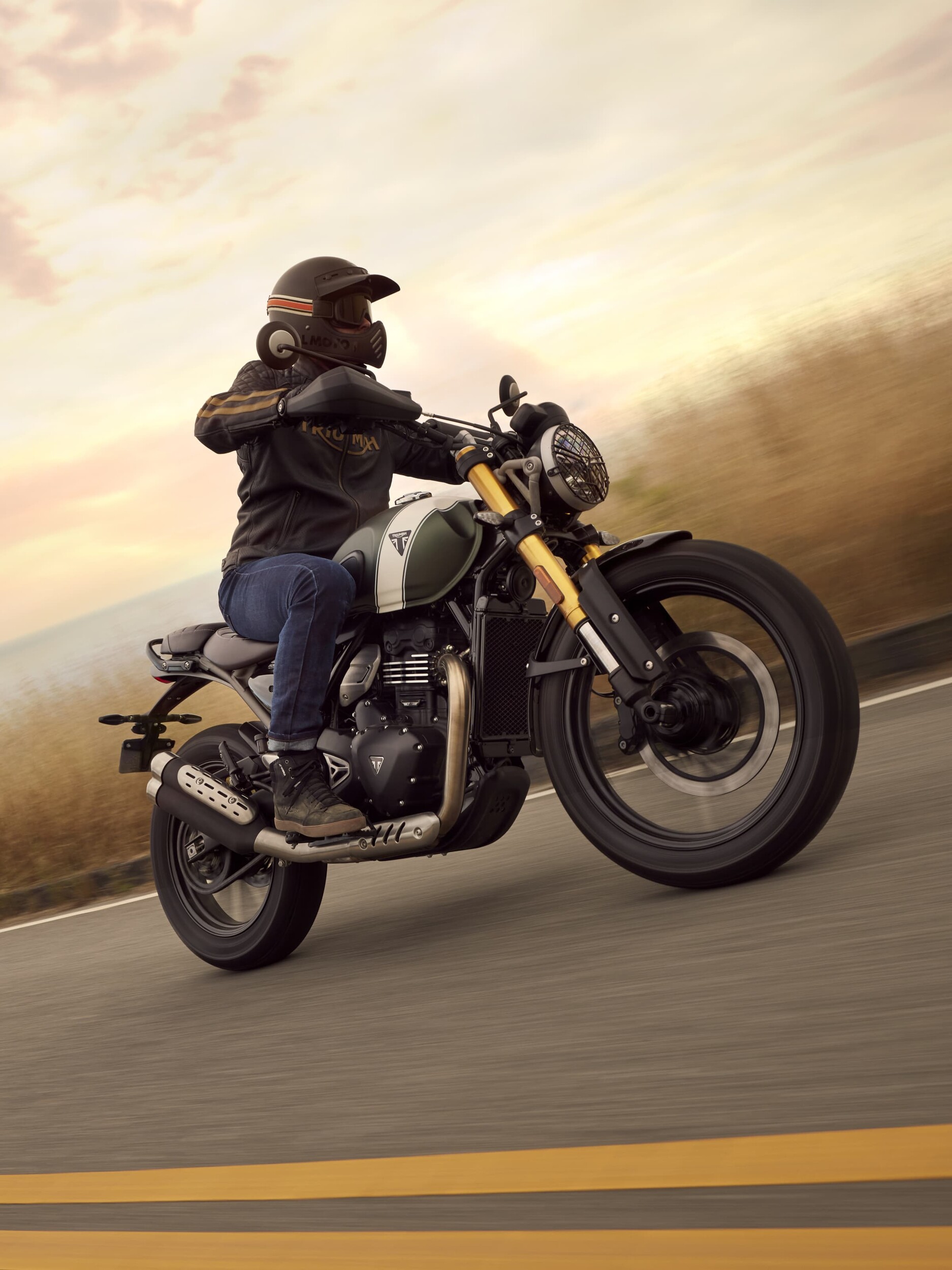 The
Scrambler 400 X combines classic Triumph styling with an upright,
all-road riding position. Image: Triumph Motorcycles.
Designed by Triumph, built
in India
The Scrambler 400 X was conceived and designed in Hinckley, with
production handled in India through Triumph’s partnership with
Bajaj.
That arrangement raises an obvious question: does it feel like a
genuine Triumph or a budget motorcycle carrying Triumph branding? In
person, the answer is reassuring.
The sculpted fuel tank, triangular Triumph badge, brushed engine-fin
detailing and prominent Triumph engine covers give the motorcycle a
clear family identity. The high-mounted twin-outlet exhaust is
especially attractive, with the brushed stainless-steel finish
developing a bronze colour as it heats and ages.
Remove the badges and it would still look like a deliberately
designed modern classic. Some cost-conscious construction is visible
around the switchgear, but the controls feel solid and the motorcycle
never feels built to the lowest possible price.
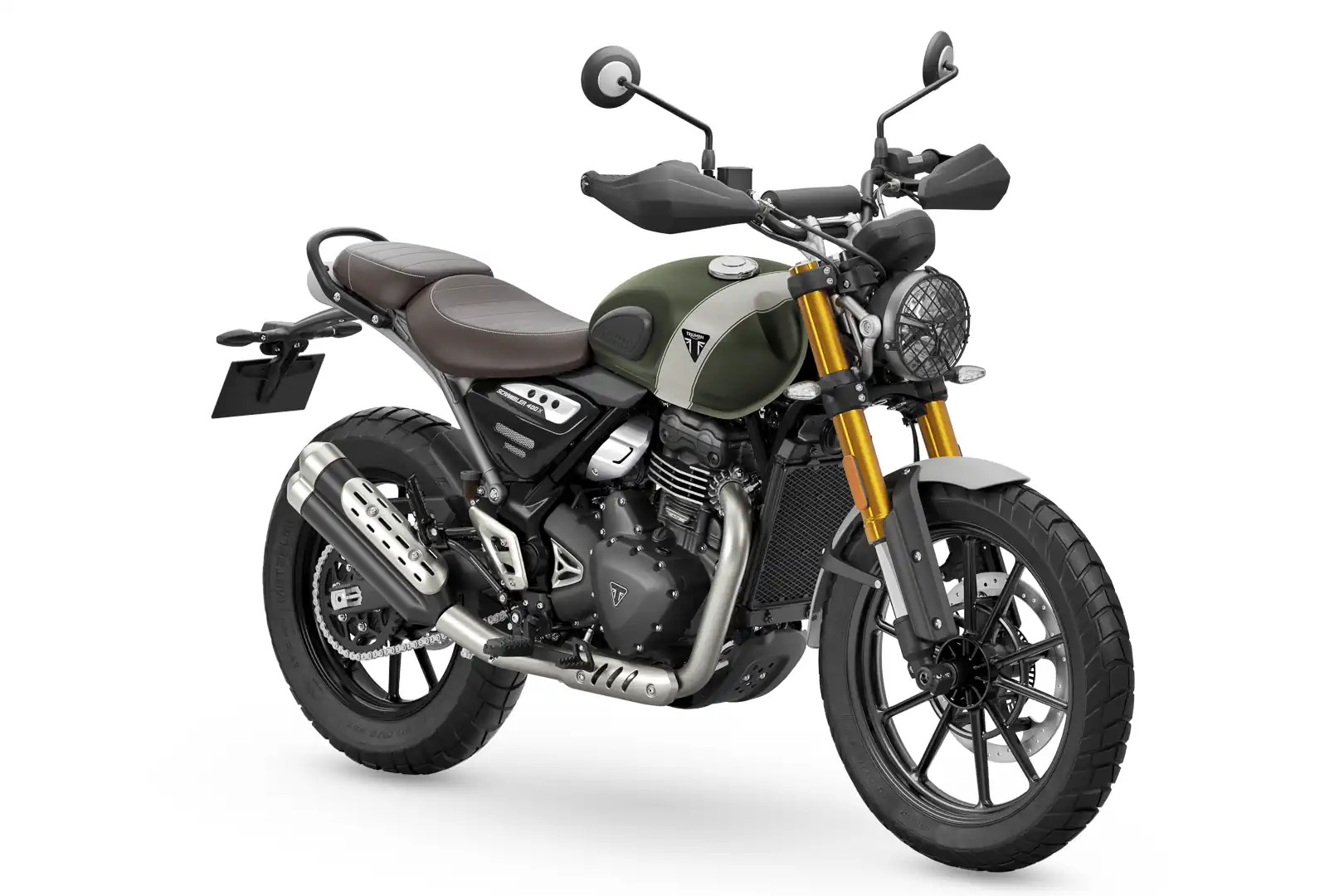 The 400 X
carries recognisable Scrambler details, including gold forks, a
high-mounted exhaust and a 19-inch front wheel. Image: Triumph
Motorcycles.
A 398 cc single with
useful performance
Power comes from Triumph’s liquid-cooled 398.15 cc TR-Series
single-cylinder engine.
In South African specification, it produces 39.5 hp (29.4 kW)
at 8,000 rpm and 37.5 Nm at 6,500 rpm, driving
the rear wheel through a six-speed gearbox and slip-and-assist
clutch.
Those figures are not intimidating, but the engine feels lively where
it matters. Throttle response is clean and it reaches higher road speeds
more convincingly than some smaller-capacity singles.
It is also impressively smooth for a single-cylinder engine.
Vibration becomes more noticeable at higher speeds—particularly through
the mirrors above approximately 120 km/h—but it is well controlled
through the handlebar, seat and footpegs.
The rubber-mounted footpegs move slightly underfoot and initially
feel unusual, but appear to contribute to the bike’s refinement.
The tachometer suggests there is more room available, but the engine
reaches its limiter at roughly 10,000 rpm. Once expected, it is easy to
work around.
The six-speed gearbox was consistently smooth. There is no
quickshifter, but gear selection is light and predictable and the ratios
use the available performance well.
 Its 398.15
cc single produces 39.5 hp and feels strongest when used through the
middle of the rev range. Image: Triumph Motorcycles.
Comfortable, upright and
easy to manage
The Scrambler 400 X places the rider in a neutral, upright
position.
The handlebar is easy to reach, the knees are not excessively folded
and the controls feel natural. Its 835 mm seat height
is relatively tall, but the narrow shape helps make it manageable.
Triumph quotes a wet weight of 179 kg, including
fuel and fluids. That is light enough to make low-speed riding and urban
manoeuvring approachable without making the bike feel insubstantial on
faster roads.
The chassis uses a tubular steel hybrid spine frame with a bolt-on
rear subframe. At the front is a 43 mm upside-down big-piston fork,
while the rear uses a gas monoshock with an external reservoir and
adjustable preload. Both ends provide 150 mm of
travel.
The suspension is comfort-oriented. On our bike’s soft preload
setting it dealt well with road imperfections, although a passenger or
luggage would justify increasing rear preload. Adjustment requires the
correct tool and some preparation.
For tar, damaged urban roads and maintained gravel, the suspension
makes sense. Riders planning regular encounters with rough trails, deep
erosion or bigger off-road impacts may find 150 mm of travel and the
cast wheels limiting.
It is a Scrambler with useful all-road versatility, not a lightweight
rally bike.
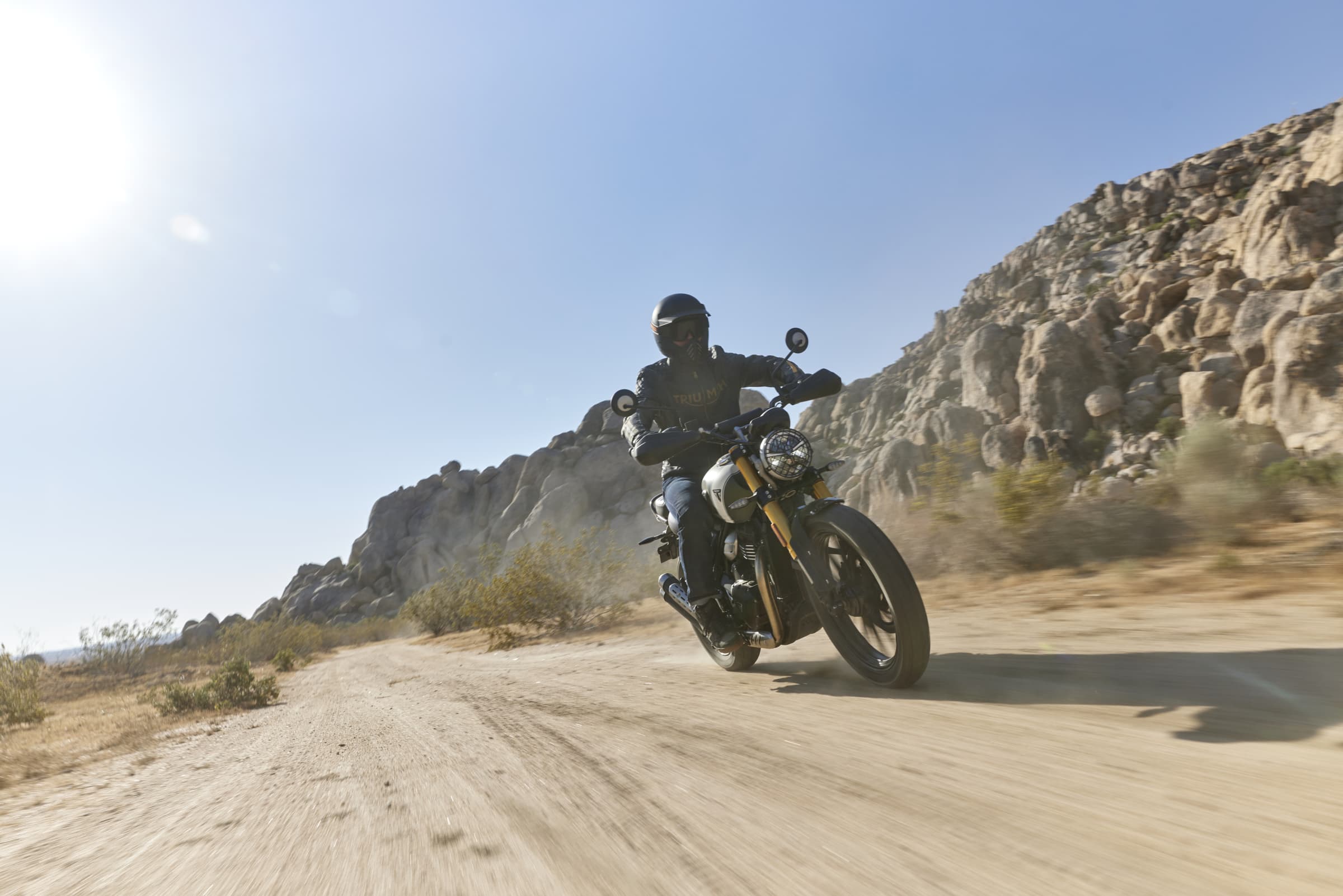
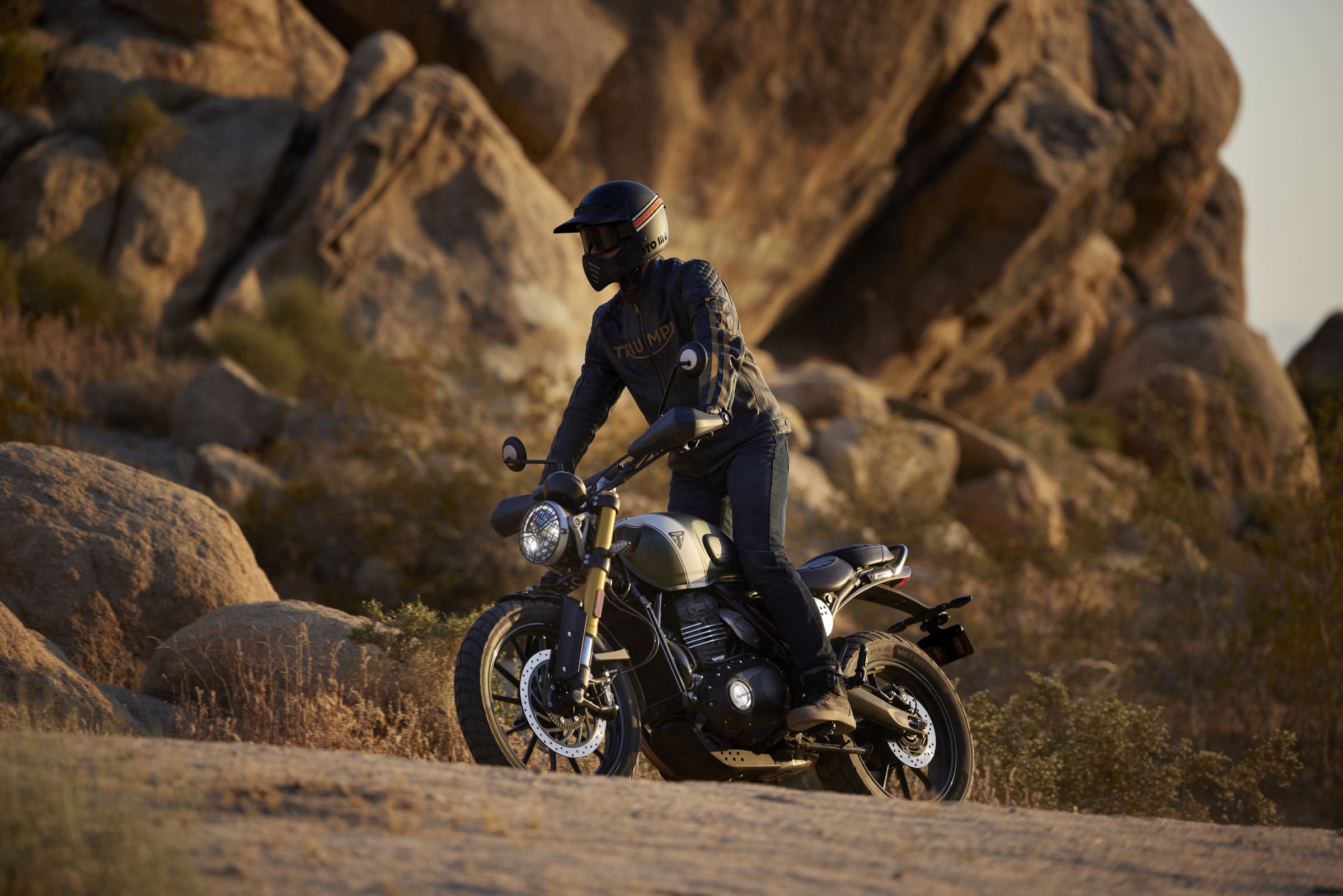 The upright
ergonomics and manageable weight help the Triumph feel approachable on
imperfect roads and easier trails. Image: Triumph Motorcycles.
Brakes, wheels and
electronics
The Scrambler 400 X uses a 19-inch cast-aluminium front
wheel and 17-inch cast rear wheel.
Braking comes from a 320 mm front disc with a radial four-piston
ByBre caliper, supported by a 230 mm rear disc and single-piston
floating caliper.
Dual-channel ABS and traction control are fitted as standard. For
loose-surface riding, the rear ABS and traction control can be switched
off.
The electronics package is intentionally simple. There is no large
colour TFT or complicated collection of modes. Our emergency-braking
test showed secure stopping, although it required more distance than the
stronger systems fitted to larger performance motorcycles.
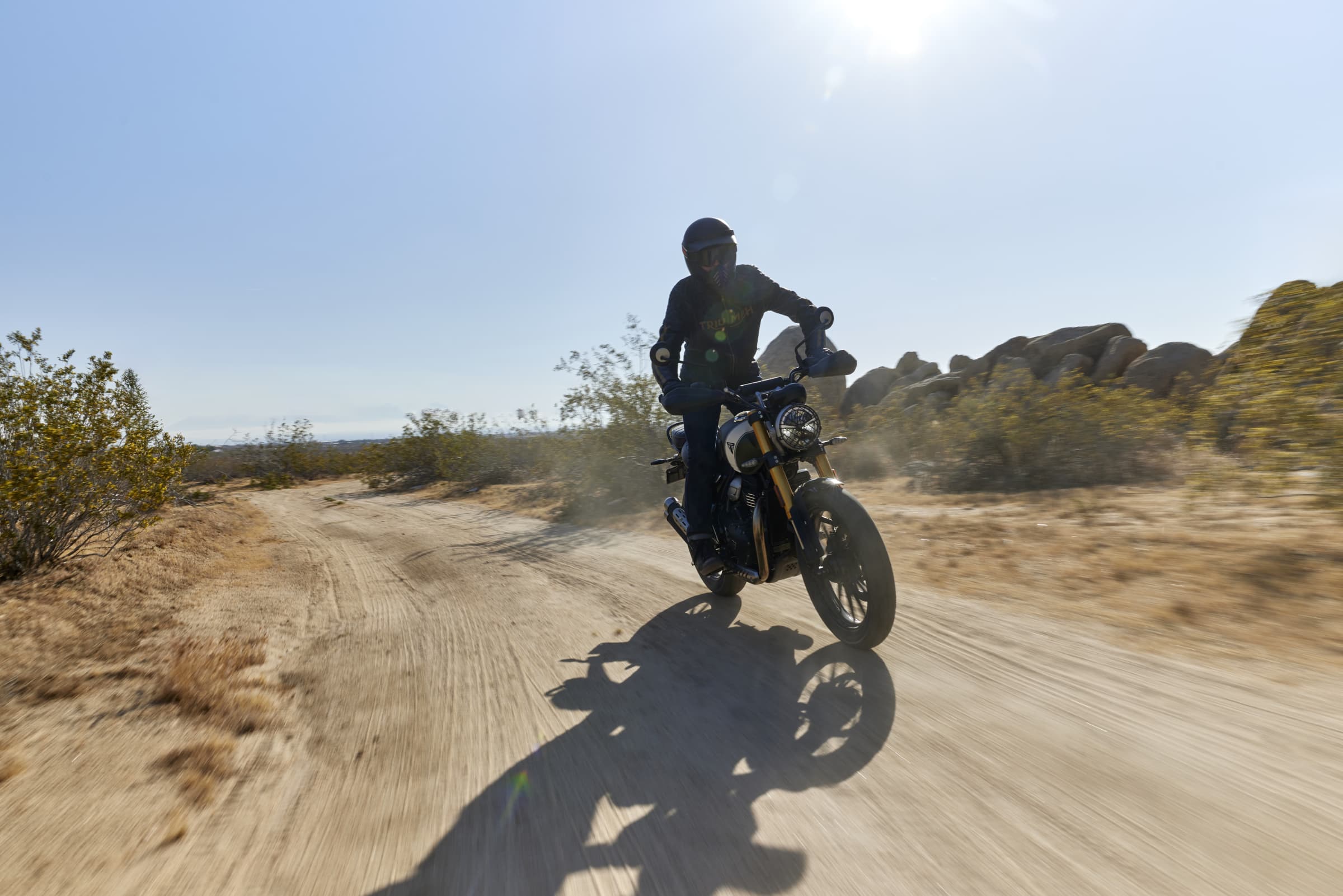 Switchable rear ABS and
traction control support light gravel riding, although the cast wheels
and 150 mm suspension travel establish sensible limits. Image: Triumph
Motorcycles.
Real-world fuel consumption
Triumph lists fuel consumption at approximately 3.5 litres
per 100 km, equivalent to roughly 28.6 km/l.
Our display indicated closer to 24 km/l, or
approximately 4.2 litres per 100 km. That remains economical.
With a 13-litre tank, that suggests a theoretical
range just above 300 km, giving the Scrambler useful commuting and
touring range.
Wind protection is minimal, as expected from an unfaired Scrambler.
It can maintain highway speeds, but sustained high-speed touring will
demand more effort from the rider than a faired adventure
motorcycle.
Excellent
lighting design, average night performance
LED lighting is fitted throughout, which is welcome at this
price.
The headlight is visually distinctive and integrates well with the
motorcycle’s modern-classic design. At night, however, we found its
illumination less convincing than its appearance.
The decorative structure creates a recognisable Triumph look, but the
useful beam comes mainly from the lower portion. High beam adds
brightness without transforming the rider’s view as much as we would
like.
Owners who regularly ride on unlit roads may want to investigate an
appropriate auxiliary-light solution.
The Torque & Throttle
Performance Index
We subjected the Scrambler 400 X to all five elements of the Torque
& Throttle Performance Index:
- 60–120 km/h in third gear
- Ten-cone handling test with a U-turn and return
- 80–140 km/h in sixth gear
- Emergency braking from 100 km/h
- 0–100 km/h acceleration
The Scrambler completed the combined test in 64.65
seconds. On the latest Torque & Throttle leaderboard, that
places it ninth overall.
It sits 3.11 seconds behind the Honda NX500 E-Clutch
and 4.22 seconds ahead of the TVS Apache RR310. It also
remains approximately 12.2 seconds behind the considerably more powerful
BMW S1000XR.
The index deliberately compares very different motorcycles across
identical challenges. The Triumph’s result reflects the road experience:
usable acceleration, manageable handling and enough top-end performance
to avoid feeling trapped within city limits.
Is it a beginner motorcycle?
It can be—but describing it only as a beginner bike undersells
it.
Newer riders should appreciate its manageable power, predictable
controls and reasonable weight. Experienced riders can enjoy using most
of its performance without immediately reaching antisocial speeds.
It is fast enough for highways, entertaining through corners,
economical for commuting and comfortable enough for longer journeys. Add
luggage and a small screen, and touring becomes realistic.
We would still choose it primarily for tar, imperfect roads and light
gravel rather than serious off-road riding. Within that role, its
versatility is one of its strongest qualities.
South African price and
value
Triumph Motorcycles South Africa currently lists the Scrambler 400 X
from R117,000, excluding optional extras and possible
delivery-related charges.
Buyers should also inspect Triumph’s approved-used listings.
Low-mileage examples can occasionally create a compelling alternative to
buying new, particularly for riders whose budget would otherwise exclude
the brand.
It costs more than a basic commuter, but its design, finish,
equipment and riding experience give it convincingly premium
character.
Torque & Throttle verdict
The Triumph Scrambler 400 X succeeds because it does not feel like an
imitation of a more expensive Triumph.
It has its own identity and a clear purpose. It looks special, feels
well assembled and delivers enough performance to remain entertaining
beyond the first few months of ownership.
The headlight could be stronger, the mirrors blur at speed and
serious off-road riders will want more suspension travel and spoked
wheels. Those weaknesses do not undermine what it does well.
It is approachable without being dull, economical without feeling
disposable and stylish without relying entirely on the badge attached to
its tank.
When we asked whether we would buy one, Tiaan, Ben and Reginald all
reached the same conclusion.
Three riders. Three votes. Three yeses.
The Scrambler 400 X earns the Triumph name—and it may be one of the
most broadly useful motorcycles in the brand’s South African range.


